 Thermoelectric materials can transform heat flow to electrical energy directly in solid states. The principle of thermoelectric power generation is based on the temperature difference between the interfaces of two different semiconductor materials. The energy exchange processes of TEG (Thermoelectric Generators) are quiet and emission-free. It has the advantages of being silent, zero-emission of greenhouse gases, a long lifespan, 24hr operation and clean energy. It can be applied to low grade waste heat recovery (below 500℃) and the installation capacity is flexible from a level of a few watts to several megawatts.
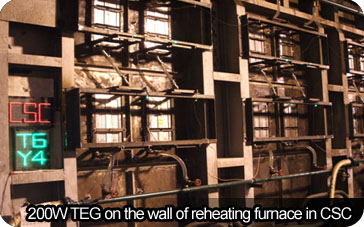
In response to the government carbon reduction policy to reduce industrial emissions and re-use waste heat, CSC (China Steel Corporation) has established a 200W pilot TEG on the wall of a reheating furnace. The wall surface temperature is about 130℃ and the TEG can generate electric energy from the waste heat of the reheating furnace wall from the thermoelectric effect. The TEG system is the first application using thermoelectric technology to recover industrial waste heat in the country. The system is shown in the photo below. It has been running nearly two years and the power generation is stable. There are 216 thermoelectric modules installed in this 200W TEG system, with a total area of 5m2, an average power density of 40W/m2, and the average temperature difference is 82 ℃ with the average temperature of the hot and cold side of the TEG system being 115 ℃ and 33 ℃ respectively.
The thermoelectric technology for industrial waste heat recovery is still being developed and has not yet reached the stage of commercialization. The main reason is the conversion efficiency is still low and costs are high. The thermoelectric module is expected to reach 7% conversion efficiency at a cost of US$2/Watt in 2015. Following this commercial application can be expected.